



The Cultural and Financial Impact of The World Cup in America
LISTEN TO SAFE 1 TALK WITH THE MONEYWISE GUYS ON THIS TOPIC!
The FIFA World Cup is more than just a collection of soccer games rolled up into a tournament – it’s a mix of sports, emotions, and cultures that rarely happens on an international level. The World Cup in 2026 was no exception to this as it, once again, put the United States on the international stage. Doing so not only showcased countless traditions uniquely American and enjoyed by our guests but also had a significant economic impact for the host cities who took part.
So, with this is mind, let’s take a look at what international travelers loved about their visit to America and how this financially contributed to a very successful World Cup 2026 for the United States.
What International Travelers Enjoyed About the United States
- Ranch Dressing – Many international travelers found ranch dressing to be fun and memorable. Since ranch is served with everything from salads to pizza to chicken wings, fries, vegetables, and sandwiches, visitors marveled at its many uses.
- Barbecue and Buffalo Wings – Not a common food experience for many European travelers and one they found quite appetizing. And, yes, they enjoyed it with ranch dressing.
- Hamburgers and Milk Shakes – Popular American cuisine was well-received amongst World Cup travelers.
- Free Refills – From soft drinks to chips and salsa to coffee, international travelers were astounded and loved the idea of getting second and third helpings free of charge.
- Ice – Foreign travelers loved the fact ice is so plentiful in the United States, as in many countries, especially Europe, it is not culturally as prominent.
- Craft Beer – Local breweries became quite popular by international tourists during the World Cup. Famously, one Boston bar ran out of beer for the first time in its history thanks to some Scottish visitors.
- Tailgating – Though common in America, the tailgating experience is not customary in other countries and became well-received and enjoyed by our international guests.
- Stadium Scoreboards – While several countries have stadiums with a much larger seating capacity than what is common in the United States, giant scoreboards are not as commonplace and something visitors found fascinating.
- Large Supermarkets – The likes of shopping in stores like Costco, Walmart, and Sam’s Club are not something found in the lives of those living abroad. As such, many international travelers could not believe the size of such shopping spaces, with some even becoming members to take advantage of deals.
- Outlet Malls – Like large supermarkets, outlet malls became very popular by World Cup travelers with many shipping some of the goods back home.
- Air conditioning – While A/C is something we take for granted in the United States, many buildings in foreign countries lack this luxury primarily due to the age of such residents. As one traveler said, “It’s summer outside but when I step into a building, it becomes winter!”
- Travel – According to many World Cup travelers, America was quite unique because traveling to various cities was truly like going to a different country – different cultures, foods, climates, and landscapes.
- In the end many international World Cup travelers found America to live up to the dream they always heard about.
The Positive Financial Impact of Hosting the World Cup
- Such enjoyment by international travelers greatly contributed to the tremendous financial impact the World Cup had on the cities which hosted the games.
- In measuring such success, metrics are defined in the following ways:
- Economic Impact – Spending in the local economy which includes hotels, restaurants, transportation, retail, and entertainment.
- Jobs – Employment supported by the World Cup events.
- Tax revenue – Money allocated to local and state governments from sales tax, local tax, hotel tax, etc.
- Financial Impact of World Cup
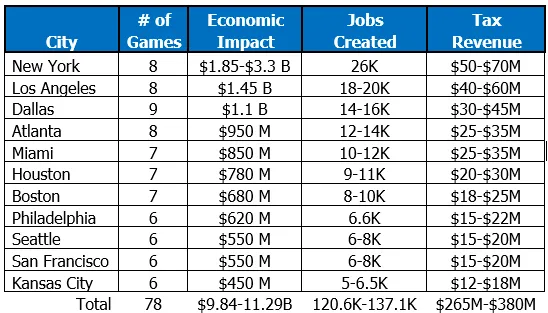
- From this data, there’s two ways to think about what cities performed best during the World Cup.
- In terms of actual dollars, jobs, and tax revenue, then, obviously, New York, Los Angeles, and Dallas were the clear winners.
- However, since smaller metropolitan areas feel a bigger percentage increase from such activity, then Kansas City, Atlanta, and Houston experienced the biggest boosts.
- Why is this?
- Well, according to economists at Oxford Economics, smaller host cities see larger percentage increases in jobs and activity because the influx of visitors represents a bigger share compared to their normal economic base, while very large tourism markets absorb additional visitors more easily.
- Nonetheless, based upon the numbers presented it is obvious all host cities were big winners during the World Cup!
The World Cup only happens every four years and, again, is one of the few times in which the entire world acts as an international community. Based upon the most recent experiences from our international visitors, not only does this time provide an opportunity to generate revenue but also learn about different cultures and traditions to bring us all together.